

 Walk Through Walls
Why ‘TINA’s’ not always right
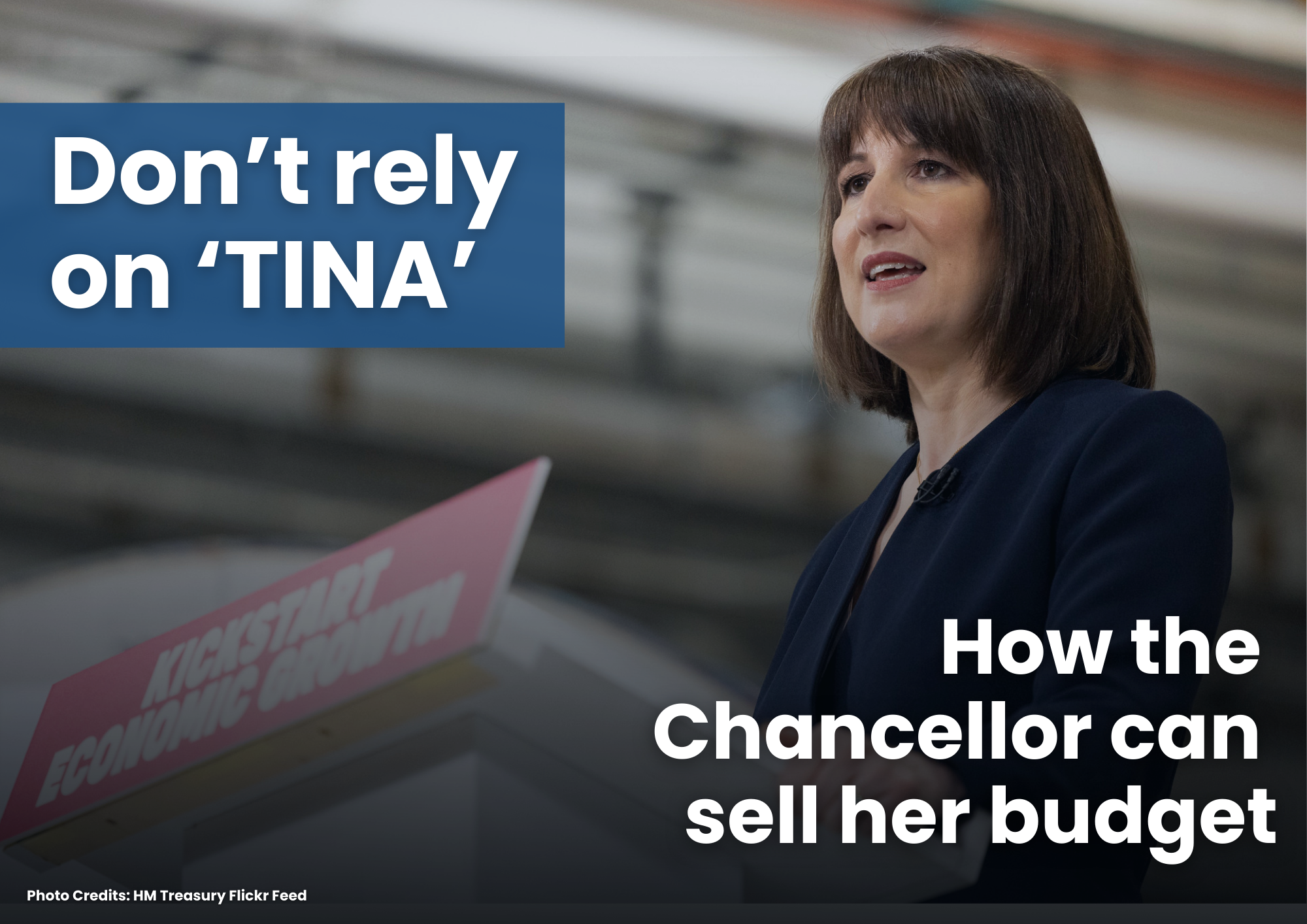
How the Chancellor should frame her choices
Whatever the difficulties facing the Chancellor this week, there’s one thing that could still make things worse…
Too often, when faced with difficult decisions, politicians resort to an old trope.
Part in search of a soundbite, part hoping for understanding, they reach for ‘TINA’: declaring ‘There Is No Alternative’.
On paper, this can sound appealing. It conveys a sense of grown-up authority; that these decisions have to be made in the national interest, and anyone who objects is refusing to engage with the reality and gravity of the situation.
The Chancellor should avoid falling into this trap
In reality, there are only a limited number of circumstances in which ‘There Is No Alternative’ resonates. And as ever, it’s all about context.
‘TINA’ works only when it truly captures the zeitgeist. When there is a broadly settled view amongst the public that drastic measures are the only course of action; when other options are so clearly nonsensical they barely need spelling out; and where easier paths have already been tried and seen to fail.
Only then do voters accept that the medicine must be unavoidably harsh. And even then, ‘we can’t go on like this’ doesn’t automatically mean ‘we like the solution’.
Use of ‘There Is No Alternative’ was popularised during Margaret Thatcher’s first term – when there was a widely held view that, following the economic travails of the 1970s, something big had to be done to reverse ‘managed decline’.
Yet even here, broad agreement over the diagnosis did not equate to consensus over the remedy – with many economists, MPs and sections of the public lined-up against her policies.
Only when difficult decisions appeared to bear economic fruit did poll ratings start to improve – bolstered by support over the Falklands War.
And while Thatcher frequently used ‘There Is No Alternative’ in rhetoric, she also vociferously defended her choices and contrasted these with the consequences of socialism.
That’s because, most of the time, deploying ‘TINA’ rarely has the intended effect.
Rather than securing buy-in, simply telling people ‘there’s no choice’ only creates more friction and resistance.
It invites others to come forward with enticing alternatives; it can suggest that other options were not truly weighed and considered; and it goes against the grain of human behaviour – which is highly resistant to forced outcomes.
Decades of research into Psychological Reactance shows that people are more likely to support something when agency is emphasised over inevitability – and they’re more likely to resist persuasion when autonomy feels constrained.
Think about it:
Would you be more likely to buy a house if an Estate Agent showed you a single property and declared ‘I’ve looked into it and this is the one – now sign here’, or would you be more inclined to make the purchase if they presented you with options, comparing the pros and cons against your requirements and allowing you to reach your own conclusion?
Even when faced with an unpalatable decision – such as undergoing potentially risky surgery – most people would prefer their doctor explains how the recommendation was reached and what alternatives were considered.
Each time, the ultimate outcome may well be the same. But the decision is reached with the person feeling they’ve made an active, informed choice. And when people believe they’ve helped shape a decision, they feel happier with the end result – even if the outcome is less favourable than first hoped.
So what does this mean for how the Chancellor should present her budget?
Expectation management does not = strategy
First, the Chancellor should resist the temptation of presenting every unpalatable measure as due to forces beyond her control.
‘Difficult backdrop’ may set the context, but it should not explain the decisions.
Instead, a government should frame its choices:
Explaining the principles upon which its choices are based, the values in which they’re rooted, the outcomes on which they’re focused. And then contrast these against the alternatives, explaining the effect these would have on the economy, public services and people’s lives.
The message should not be ‘There Is No Alternative’, it should be ‘These are our choices’ – with the alternatives, and their consequences, clearly spelled out.
Learning from last year’s budget, the Chancellor has in fact adapted her language in recent months: from declaring ‘We had no alternative’ to the CBI last November, to ‘These are my choices, these are Labour choices’ at the Spending Review in July.
But these choices also need to be set within a wider narrative.
Lowering expectations before a budget may be a time-honoured tactic, but it is not a long-term strategy.
Leaving voters and businesses thinking ‘it could’ve been worse’ may buy a government some time, but as a comms strategy it’s unambitious to say the least.
A more compelling narrative would be that, faced with difficult choices, the government is taking bold decisions for a brighter future.
This requires accepting that some people will be unhappy with those decisions, but that a coalition of support can be built when choices are properly explained – and a destination point plotted.
It also requires a willingness to take those bold decisions; to turn a difficult situation into a catalyst for change; to reshape the state, rebuild the tax system, and recast the narrative.
Whether or not the Chancellor has such bold plans up her sleeve, we will soon be able to judge.
It’s all about differentiation
The reason ‘There Is No Alternative’ tends to fail is because it is not fundamentally about differentiation. And differentiation drives choice.
This is where there are parallels with the way companies need to communicate their offer to customers, clients and the public.
As in politics, a business has to explain why people should choose it over rivals. What differentiates it from alternatives, why its product or service is better, the reason customers should feel compelled to buy.
When people are guided towards a decision using choice architecture, persuasion and differentiation, they are more likely to stick with that decision, feel more satisfied with the outcome, and therefore repeat it again in future.
Behavioural scientist Robert Cialdini called this the power of self-initiated commitment. And the potency of guided choice has been demonstrated time and again, from Thaler & Sunstein’s Nudge research to the government’s own behavioural insights team.
So whether in business or in politics, if people are presented with a single option and told: ‘There Is No Alternative’, don’t be surprised if the thought emerges: ‘Well, perhaps there is?’
By Antony Morrison, Former CCHQ Head of Campaign Communications


Walk Through Walls